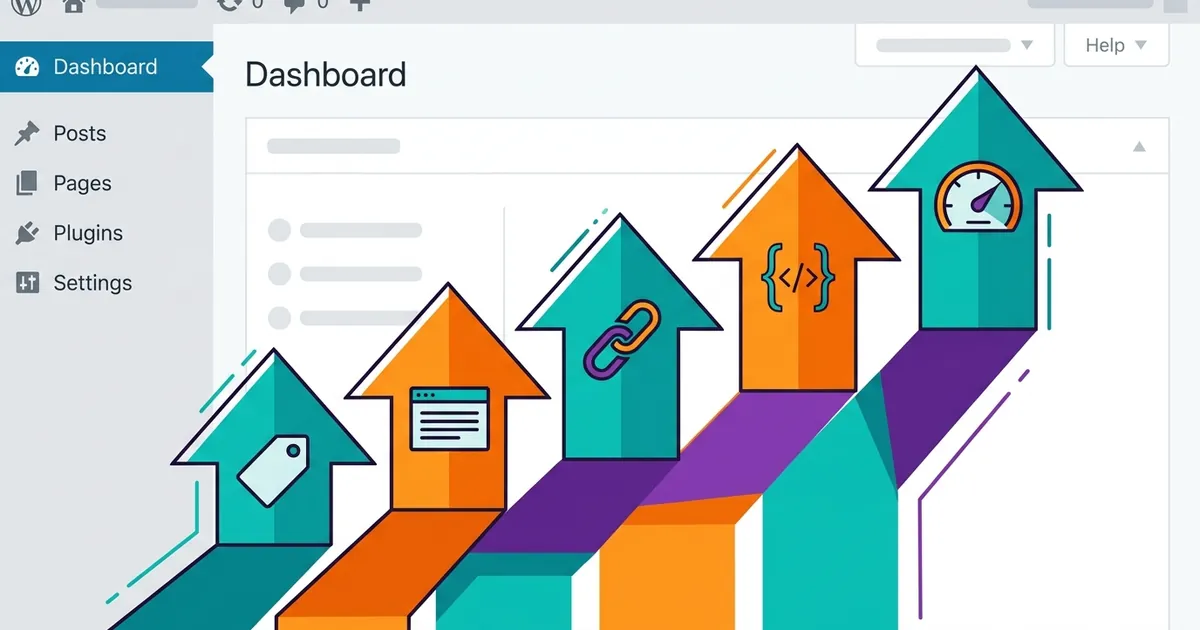
If your WordPress site is stuck on page two of Google—or you’re getting steady impressions but almost no clicks—you don’t need a complete redesign. WordPress SEO quick wins are low-effort optimizations targeting pages already receiving attention from search engines. They work because they fix what you have instead of forcing you to build from scratch.
The fastest movers live in positions 11–20. These pages have Google’s trust, rank for real search intent, and need only small structural or technical fixes to jump to page one. Title tags, meta descriptions, internal links, and content refreshes show measurable movement within 2–4 weeks. Even a 30-minute optimization session per page compounds quickly across 10–15 articles.

Title tags and meta descriptions: your 20% CTR boost
A strong title tag and meta description don’t directly change rankings, but they change whether someone clicks your result. Title tag optimization alone lifts click-through rate by 20% or more, and the work takes five minutes per page.
The formula is simple. Start with your primary keyword, add an emotional word or number that signals value, then your brand name. Stay under 60 characters to avoid truncation. Instead of “WordPress Blog Post,” write “WordPress SEO Quick Wins: 5 Immediate Changes.” The second one wins clicks because it promises specificity and speed.
Meta descriptions are your second 30-second fix. They should include the primary keyword, a benefit statement, and a micro-call-to-action. Keep them between 150 and 160 characters. Weak: “Learn about WordPress SEO.” Strong: “Implement 5 WordPress SEO quick wins in 2–4 weeks. See results fast.” The difference in click-through rate compounds across your entire site.
WordPress plugins like Yoast SEO and Rank Math let you edit and preview both fields directly in the editor. Test your titles and descriptions using Google Search Console within two weeks of publishing to confirm the lift in impressions and clicks.
Internal linking: connect your existing wins
Internal links distribute authority between your own pages without requiring a single external backlink. They guide Google’s crawl, improve page discoverability, and keep readers moving through your content. When you link from a high-authority page to a lower-ranking one using descriptive anchor text, you’re accelerating that lower-ranking page’s climb.
Start with your best-performing posts. If your “WordPress SEO guide” ranks well and gets steady traffic, it’s a source of authority. Find 2–3 related posts that lag in rankings—perhaps “WordPress speed optimization” or “WordPress security checklist”—and link to them from your guide using specific anchor text like “WordPress SEO fundamentals.” This passes authority without diluting your main page’s focus.
You can discover linking opportunities in 30 minutes by searching your WordPress site for related keywords or using a plugin like Internal Link Juicer. The result is improved crawlability, distributed authority, and faster ranking movement for target pages. After adding internal links to existing content, pages typically show ranking improvements within 3–5 weeks.
Page-two keywords: your fastest path to page one
Pages ranking in positions 11–20 are your quickest wins. They’re already visible to Google and searchers, but losing to competitors by a thin margin. Minimal extra effort moves them forward because the search intent alignment is already there.
Pull a Google Search Console report filtered to positions 11–20, sorted by impressions. Look for pages with 200 or more impressions but click-through rates below 5%. These are ready to move with title and meta optimization alone.
Check how page-one competitors structure their content. If searchers want a step-by-step guide, your content should have numbered headers and a checklist, not paragraph prose. If competitors show a video, add one. This is search intent alignment—matching your format and content depth to what the top results already do. The page is halfway there; tighter intent matching pushes it the rest of the way.
Typical timeline: combined title optimization, internal link addition, and content restructuring move page-two keywords to page one within 4–6 weeks. Moving from position 15 to position 5 can increase click-through rate by 300% or more, so even a single page’s climb pays off immediately.
Schema markup and Core Web Vitals: the technical foundation
Schema markup doesn’t directly boost rankings, but it improves your eligibility for rich snippets and AI-generated answers. As search results evolve in 2026, sites with schema see higher visibility and click-through rates. Core Web Vitals—the three metrics Google uses to measure page speed and responsiveness—are ranking signals and conversion drivers. Even a 0.1-second improvement in load time increases conversions by 8.4% for retail and 10.1% for travel.
Start with schema. WordPress plugins like AIOSEO and Rank Math auto-generate schema for articles, products, FAQs, and local business pages. Enable schema for your post type in plugin settings (no coding required), then test using Google’s Rich Results Test. The whole process takes 10 minutes and qualifies your pages for richer search appearances.
Core Web Vitals comprise three metrics: Largest Contentful Paint (LCP, loading speed), Interaction to Next Paint (INP, responsiveness), and Cumulative Layout Shift (CLS, visual stability). Quick fixes include enabling GZIP compression, lazy-loading images below the fold, and minifying CSS and JavaScript. A caching plugin like WP Rocket or NitroPack handles these in one click. A concrete example: a product page with a 4.2-second LCP dropping to 2.8 seconds via image optimization typically sees 2–3 ranking position gains within three weeks.
Using AIOSEO or Rank Math for schema and on-page checks
Both plugins offer free tiers with schema auto-generation. Enable schema for your post type (Article for blogs, Product for ecommerce) in the plugin settings. Use the on-page SEO score to catch title length, readability, keyword placement, and meta description gaps in a single pass. Rank Math includes AI-powered content suggestions; AIOSEO focuses on technical accuracy and automated cleanup. Either way, you’re catching fixable issues before publishing.
Content refresh for existing impressions: minimal effort, proven impact
Old posts receiving steady but stagnant impressions are ripe for refreshing. Add new research, update screenshots, embed a recent example, or add a video. Posts with video see a 157% increase in organic search traffic potential—a single 60-second walkthrough transforms an entire post.
Search Console shows the refresh threshold: look for posts with more than 50 impressions, fewer than 5 clicks, and older than 30 days. The workflow is straightforward. Add two paragraphs of new research, embed a relevant YouTube video or screencast, update the publish date to the current month, and republish. Google recrawls refreshed content within 2–4 days; impression and CTR improvements appear within 1–2 weeks.
A 2024 WordPress SEO post updated in May 2026 with current data and a demo video typically gains 20–40% impression lift within 30 days. This is not new content creation; it’s resurfacing and strengthening what already exists. The domain authority, backlinks, and keyword history stay intact, so you’re only fighting a small battle against recency. If keeping a steady refresh cadence feels like too much to maintain manually, Makasete’s automated weekly article service publishes SEO-optimized content directly to WordPress from $40/month, keeping your site’s freshness signals active without the manual workload.
How to prioritize: the quick-win framework
All five quick wins matter, but order matters more. Title and meta optimization shows results fastest (2–4 weeks). Internal linking follows closely (3–5 weeks). Technical fixes and content refresh land simultaneously but compound over time.
Start with Search Console page-two keywords. These have high intent and low effort to move. Batch title and meta updates for 10–15 pages in one afternoon using a spreadsheet and WordPress bulk editing. While those propagate, identify internal linking opportunities and outline content refreshes for your highest-traffic posts.
Don’t wait for perfection. Publish title and meta updates while you plan internal links and technical fixes in parallel. Lean teams and solo founders can complete these five quick wins across 5–10 pages in a single week using WordPress plugins and Search Console, then track improvements monthly. The framework itself is free to implement yourself, or you can accelerate the process using tools—from plugins like Rank Math and AIOSEO to comprehensive WordPress SEO best practices guides and automated publishing platforms that handle content refresh at scale.
Set realistic expectations. Five to ten pages optimized across all five quick wins should show measurable traffic lift—10–15% impressions—within six weeks. That momentum compounds. By month three, double-digit percent increases in clicks and impressions are standard when starting from modest baseline traffic.