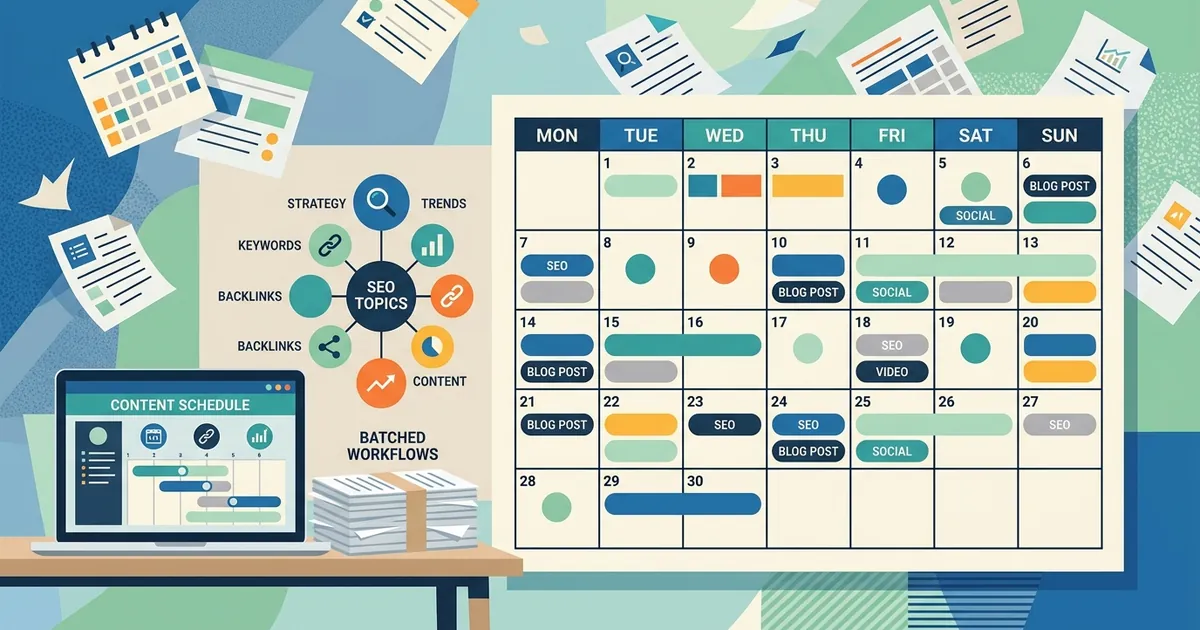
A content calendar maps topics, formats, publish dates, and SEO keywords weeks in advance. It solves content marketing’s #1 failure point: inconsistency. Planning reduces decision fatigue, maintains steady publishing, and aligns content to core themes. The result is predictable organic growth and better rankings.

Ideal publishing frequency for lean teams
Consistency beats volume. A realistic range works for teams with limited resources.
For a solo founder, one article per week yields measurable SEO results within three months. Teams of two to three with automation can manage two to three posts per week in five hours.
52 consistent posts per year outperform 12 scattered posts. Start with one per week, measure your 90-day rankings, then scale.
AI services like makasete ($40/month) handle keyword research, writing, and publishing automatically, enabling two-to-three weekly posts without manual effort.
Building your calendar template and choosing tools
Your calendar needs to be used, not fancy.
Essential calendar fields: topic, format, publish date, author, platforms, SEO keyword, CTA, status, and final link. Status tracking prevents missed deadlines and keeps teams aligned.
Free options (Google Sheets, Notion, Trello, WordPress Editorial Calendar) suit teams under five people. Google Sheets integrates with Analytics; Notion offers better visuals; WordPress Editorial Calendar has native scheduling.
Structuring a 12-month content plan with content pillars
Start with three to five content pillars—core themes addressing customer problems. Examples: SEO fundamentals, content strategy, ROI measurement (marketing agency); nutrition, training, health (pet supplies). Pillars prevent drift and build topical authority.
Aim for 80% evergreen content (how-tos, guides, definitions) and 20% reactive pieces (trending news, timely tips). Reserve 10–20% of slots open for agility and unexpected opportunities.
Divide your year into quarterly planning sprints: January (Q1), April (Q2), July (Q3), October (Q4). This reduces cognitive load and lets you apply prior quarter learnings.
A 70/30 blend of new content to refreshed older pieces boosts your SEO signal—updated posts see 2.8x stronger results than fresh-only publishing.
Example: three-pillar structure for a marketing agency
Pillar 1: SEO fundamentals (keyword research, on-page optimization, technical audits). Pillar 2: content strategy (workflows, ideation, repurposing). Pillar 3: ROI measurement (Google Analytics 4, attribution, performance analysis).
Each pillar gets four to six articles per quarter. This ensures balanced coverage across your core topics and builds enough topical authority that Google recognizes your site as an expert in each area. When Google sees multiple related posts linking to a pillar article, it understands the relationship and ranks your content higher for related searches.
Batch content production: workflow and time allocation
Batch production groups similar tasks (research, writing, editing, design) to minimize the context-switching cost. Your brain loses 23 minutes of focus every time you switch between tasks. Batch work eliminates that friction.
A typical weekly allocation for a solo founder looks like this: one to two hours on strategy and planning (usually Monday morning), two to three hours on a focused production block (not scattered throughout the week), and two to three hours on distribution and measurement. A five-day structure works well: Day 1 (brainstorm and outline), Day 2 (draft), Day 3 (edit and add images), Day 4 (peer review or self-review), Day 5 (schedule and publish).
Batch production amortizes your research overhead. Researching three topics at once and outlining three pieces on the same day costs far less time and mental energy than researching one topic, waiting three days, researching the next, and so on. You stay in “research mode” and reuse frameworks across multiple pieces. You also prevent decision fatigue: commit to your week’s topics Monday morning, then execute without daily pivot requests derailing your schedule.
For teams that can’t dedicate five hours weekly, automation changes everything. A higher-frequency plan like daily article publishing (demonstrated at $200/month in case study) shifts the batch work from your brain to an AI pipeline. The 8-step AI content pipeline (keyword research, topic design, outline, writing, fact-checking, image generation, SEO scoring, and WordPress publishing) handles the heaviest tasks automatically, leaving you with only high-level approval instead of grinding through research and drafting. This isn’t a shortcut—it’s a way to make consistency possible for founders who genuinely cannot block five hours per week.
SEO fundamentals to embed in your calendar
Your calendar should never be disconnected from keyword strategy. Keyword research precedes calendar population. Before you assign a single topic to a date, identify 50 to 100 target keywords that mix high-volume terms with low-competition opportunities. This ensures every article you write has a fighting chance of ranking.
Within each pillar, organize content into topic clusters: one broad pillar article and three to four narrower cluster articles that link back to the pillar. A pillar article on “SEO fundamentals” might link to cluster articles on “keyword research tools,” “on-page optimization checklist,” and “meta descriptions.” This structure tells Google that your site is comprehensive and interconnected, which improves rankings across the cluster.
Your calendar should include the target keyword, search intent (informational, commercial, or transactional), and approximate monthly search volume for each piece. This information becomes critical when you’re reviewing performance later and deciding what to double down on. Evergreen content typically ranks within 60 days of publication. Meaningful traffic growth appears by month three or four. Compounding returns—where consistent publishing multiplies your traffic—kick in at six months and accelerate from there.
Google treats regular publishing as a freshness signal, especially for emerging sites competing in crowded niches. When it sees you publishing every week, it crawls your site more frequently and indexes new content faster. A single well-researched, SEO-optimized article becomes five to ten pieces when you repurpose it into social clips, checklists, infographics, and email guides. Your calendar should reserve production time for this repurposing work, because one pillar article can fuel weeks of downstream content.
To research keywords for your planned content and then align your calendar with SEO best practices, start with your pillar keywords and build cluster topics around them. Each cluster piece should target a more specific keyword variation or long-tail phrase that your audience actually searches for.
Tracking progress and adjusting your calendar
Your calendar is a living document. Build in a monthly review cadence to assess what’s working.
The metrics that matter most are organic traffic from Google Analytics 4, keyword rankings from Google Search Console, click-through rate, time on page, and conversion rate (if you track it). Monthly reviews answer three questions: Which pillar drove the most traffic? Which content formats underperformed? Which keywords ranked better than expected?
Double down on winners. If pillar topic A generated 40% of your monthly organic traffic, allocate more calendar slots in the next quarter to variations on pillar A. Kill underperformers ruthlessly. If a content format (say, comparison posts) consistently ranks below page 3 of Google, pause that format and redirect effort toward proven winners. This isn’t failure—it’s learning.
Use quarterly planning sprints to adjust based on actual data. Your January plan assumed certain traffic outcomes. By April, you have three months of real ranking and traffic data. Incorporate those insights into your Q2 calendar. Set baseline expectations clearly: expect zero traffic in weeks one through four, negligible traffic weeks five through eight, and measurable traffic by week 12 (at around 12 posts published). Growth accelerates by month four and compounds from there.
Avoiding common calendar mistakes
The most frequent mistakes tank calendars before they deliver results.
Overstuffing the calendar with unrealistic targets (10+ posts per week) is the fastest way to burn out and abandon it by month two. Set a frequency you can actually sustain, even if it feels slow. Publishing four solid articles per month beats publishing eight mediocre ones and skipping the next month entirely.
Ignoring keyword research before populating your calendar means publishing random topics that generate zero search traffic. You feel productive. Your calendar looks full. Your site traffic doesn’t move. Always research keywords first.
Failing to reserve buffer time creates a brittle calendar that breaks under pressure. Leave 20% of your slots open for unexpected priorities or high-performing reactive content. A perfectly packed calendar with zero slack is a calendar that will have missed deadlines.
Treating your editorial calendar and SEO calendar as separate systems causes duplicate work and conflicting schedules. Merge them into one source of truth. One calendar, one keyword strategy, one status tracking system.
To automate your content creation process, you can streamline your content production workflow using tools that handle writing and publishing. This removes the biggest friction point and makes consistency possible for teams that would otherwise struggle to hit weekly deadlines.