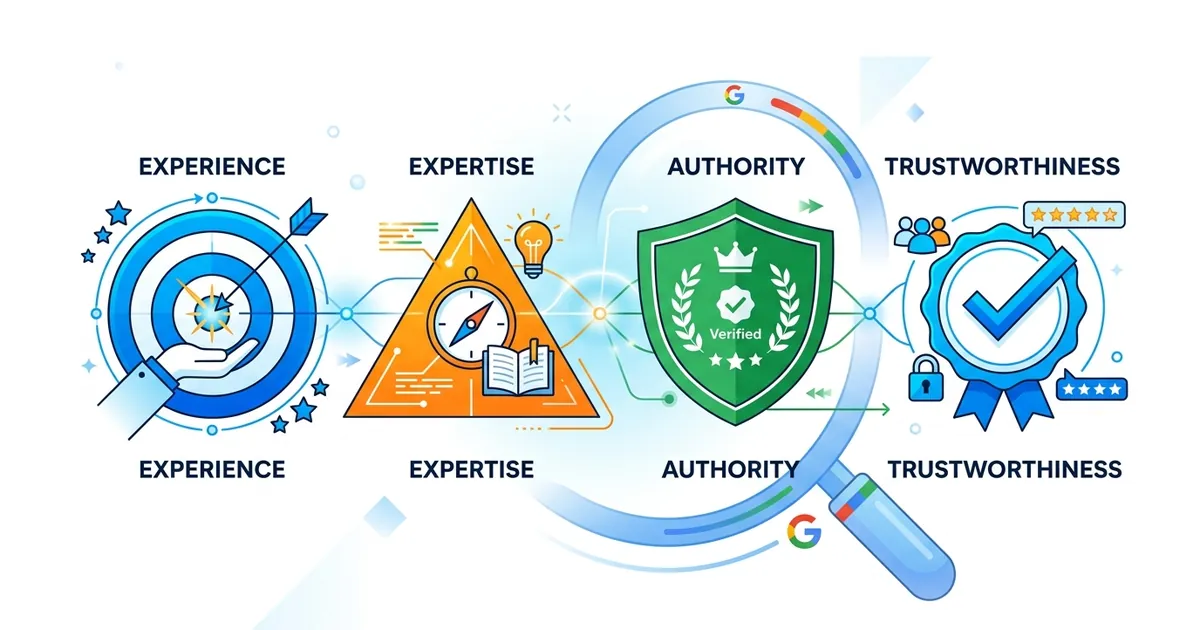
Google’s E-E-A-T and Google quality signals form the backbone of how the search engine now ranks content. E-E-A-T stands for Experience, Expertise, Authoritativeness, and Trustworthiness — four pillars that Google uses to separate genuinely helpful information from low-quality filler. This framework isn’t a direct ranking factor you can optimize like keywords or load speed. Instead, it shapes the signals Google’s algorithms use to evaluate content quality. Think of it as the invisible standard that determines whether your article reaches thousands of readers or sits buried on page five.
Why does this matter in 2026? Because approximately 40-60% of websites experienced measurable ranking changes after the December 2025 Core Update, with many losing visibility, and the common thread wasn’t technical errors — it was content quality. Sites with poor technical performance experienced 23% more traffic loss than faster competitors with similar content quality, while content farms dropped three to eight positions. Google has made clear that it’s raising its standards across virtually all competitive queries, not just health and finance topics where expertise was always critical.

The four pillars: what each one means
E-E-A-T works as a system with trustworthiness as the master pillar — the other three exist to build it.
Experience means you’ve actually done, used, visited, or tested what you’re writing about. Google added the second ‘E’ in December 2022 specifically to account for first-hand, lived experience as a quality signal. Before this change, a generic review could rank as well as one from someone with hands-on experience. Today, it doesn’t. Specificity and authentic detail matter more than credentials alone. Mention the specific model, exact games tested, temperatures measured. Vague claims no longer suffice.
Expertise is depth of knowledge visible in technical terminology, argument structure, and nuance only practitioners include. An expert on coffee roasting discusses extraction rates, bean origin, and grind consistency. Expertise must be demonstrable through what you write, not just asserted.
Authoritativeness is external recognition: backlinks, author credentials, professional affiliations, and entity-level signals connecting you to your organization. A therapist publishing on their clinic’s website benefits from personal credentials and the clinic’s track record.
Trustworthiness is accuracy, transparency about sources, clear author identity, and consistency across your site. Link to sources, provide author bios, and avoid contradictions.
Why first-hand experience changed the game in 2022
Google added Experience because AI and automated content mimic expertise signals but rarely reflect lived experience. A personal review from someone who owns and has used an item beats a generic one written by checking off features.
In categories where hands-on knowledge is possible (reviews, fitness, cooking, travel, DIY), lived experience is now a competitive advantage. Document what you’ve done, show before-and-after results, and include mistakes made. These details signal authenticity.
How Google actually measures E-E-A-T signals
Google employs a team of Search Quality Raters who evaluate content against the company’s 182-page Quality Rater Guidelines, which embed E-E-A-T criteria throughout. These raters don’t directly change your rankings. Instead, their feedback trains Google’s algorithms to recognize patterns that separate high-quality content from low-quality content. It’s a feedback loop: humans rate, algorithms learn, then the algorithms are applied at scale to millions of pages.
The evaluation focuses on three questions: Who created the content, how was it produced, and why was it created? Google looks at whether the creator has relevant experience or credentials, whether the content shows signs of careful research and fact-checking, and whether the site has a legitimate reason to exist beyond gaming search rankings. A review site built by someone actually testing products passes. A review site scraping competitor content and rewriting it fails.
Specificity and verifiable claims carry more weight than generic assertions. If you claim a tool “saves time,” you’ll need to quantify it: “This integration cut our manual data entry time from 90 minutes daily to 15 minutes.” If you cite research, link to the actual study. Measurable outcomes beat vague promises.
What changed in the December 2025 Core Update
The December 2025 update extended E-E-A-T evaluation far beyond YMYL (Your Money or Your Life) topics. It now applies to entertainment, lifestyle, affiliate content, product reviews, and virtually any competitive query. Demonstrated experience became a major competitive differentiator. In the AI era, human practitioners can leverage hands-on knowledge as their edge against automated competitors. A fitness instructor writing about kettlebell technique from 20 years of coaching experience now has a meaningful advantage over AI-generated fitness content, even if the AI content is technically accurate.
Google also began treating content clusters as quality units rather than evaluating individual pages in isolation. If your site publishes conflicting information across different articles, or if some pages are high-quality while others are thin, Google flags the entire topical cluster as inconsistent. This means E-E-A-T quality needs to be consistent across related pages.
Building E-E-A-T: practical steps for your site
Start with the author. Include a named author bio with verifiable credentials or relevant lived experience. Generic bylines like “Staff Writer” tell readers nothing. A named author with a professional history, certifications, years in the field, or specific examples of work done builds credibility. If you’re using AI tools to accelerate writing, assign a named human as the author who takes responsibility for fact-checking and accuracy — that human is the author, and the tool is the assistant.
Create a detailed About Us page that explains your site’s mission, editorial standards, and why you’re credible in your niche. Link author bios back to this page. Use author schema markup and entity-level authority signals to help Google connect authors and content to your organization’s identity.
Document first-hand experience through case studies, before-and-after examples, and specific details that only practitioners would know. If you’re in product reviews, own and use the products yourself. Include specific details: how long you’ve owned it, what you tested, failure modes you discovered. Link to your purchase history if possible, and use your own photos instead of stock images. These details signal genuine experience.
Gather customer reviews, testimonials, and third-party endorsements as trust signals. Build relevant backlinks from authoritative sources in your niche — each link acts as a citation of your authority. Maintain consistent factual accuracy and cite primary sources. When you make mistakes, correct them visibly and publicly. Transparency about errors and sources builds trustworthiness faster than trying to hide them.
For small teams managing volume, automated content systems that incorporate author credibility signals, thorough fact-checking, and automated fact-checking capabilities in AI tools can multiply your E-E-A-T efforts at scale. Consistency and verification become force multipliers when you’re balancing quality with frequency. The Automated weekly SEO article service for WordPress sites (from $40/month) model, for example, handles keyword research, outline design, drafting, fact-checking against current sources, and publication — leaving your subject matter expertise to direct the strategy and review the output for accuracy.
YMYL topics and stricter E-E-A-T rules
YMYL topics cover health, finances, legal matters, safety, and civic well-being — anything where bad information causes real harm. The September 2025 update expanded this category to explicitly include government information, elections, and civic trust. E-E-A-T requirements for YMYL are substantially stricter than general content. Expertise must be verifiable through documented qualifications or professional background, not just lived experience.
You can write a product review based on personal use. You cannot write medical advice based on personal experience. You can write about your experience recovering from an injury. You cannot write a general guide to treating injuries without professional qualifications. For YMYL content, every factual claim must be sourced, every author must be named and credentialed, and every page must cite authoritative references. The bar is high because the stakes are high.
AI-generated content and E-E-A-T: the 2026 reality
Google does not penalize AI-generated content by default. It penalizes low-quality, unedited AI content that lacks genuine expertise, accuracy, or original value. AI content can satisfy E-E-A-T guidelines when it’s thoroughly reviewed by a subject matter expert, enriched with original insights and real data, and attributed to a named author taking accountability. The origin of the draft matters far less than the quality of the final output and who reviewed it.
The key is demonstrating that a human with expertise reviewed and took responsibility for the final work. If you use AI to draft articles, your job is to fact-check every claim, add specific examples and original research, and ensure the article reflects your actual knowledge of the topic. AI tools used transparently as assistants — drafting, outlining, structuring, checking facts against current sources — can boost content velocity while human oversight maintains credibility. This model, combining human editorial oversight with AI fact-checking, is a proven path to maintaining E-E-A-T at scale without hiring additional staff. For small teams publishing across evaluating content quality standards, this trade-off lets you maintain consistency and frequency without sacrificing expertise.
Common E-E-A-T mistakes and how to avoid them
Claiming expertise without backing it up is the most common mistake. Don’t assert authority — demonstrate it through specifics, examples, and credentials. Google rewards detail, not assertion.
Hiding author identity is another. Use named authors with bios, not generic bylines. Transparency is a trust signal.
Publishing unedited AI content treats the tool as a finished product rather than a draft. The origin matters less than the quality and oversight. Assign a named human reviewer who takes accountability.
Writing about YMYL topics without documented qualifications is disqualifying. Credentialing is non-negotiable for high-stakes topics.
Mixing original research with unattributed sources blurs your credibility. Citation and transparency separate trustworthy content from hollow claims. Give credit where it’s due, and build visibility to AI systems and LLMs by structuring your authoritative claims with clear, cited evidence that machine-readable systems can extract and verify.