A blog post sits on your site, attracting readers and generating traffic for months—then it falls away as new content pushes it down the feed. You wrote it once. You could get three times the mileage from it.
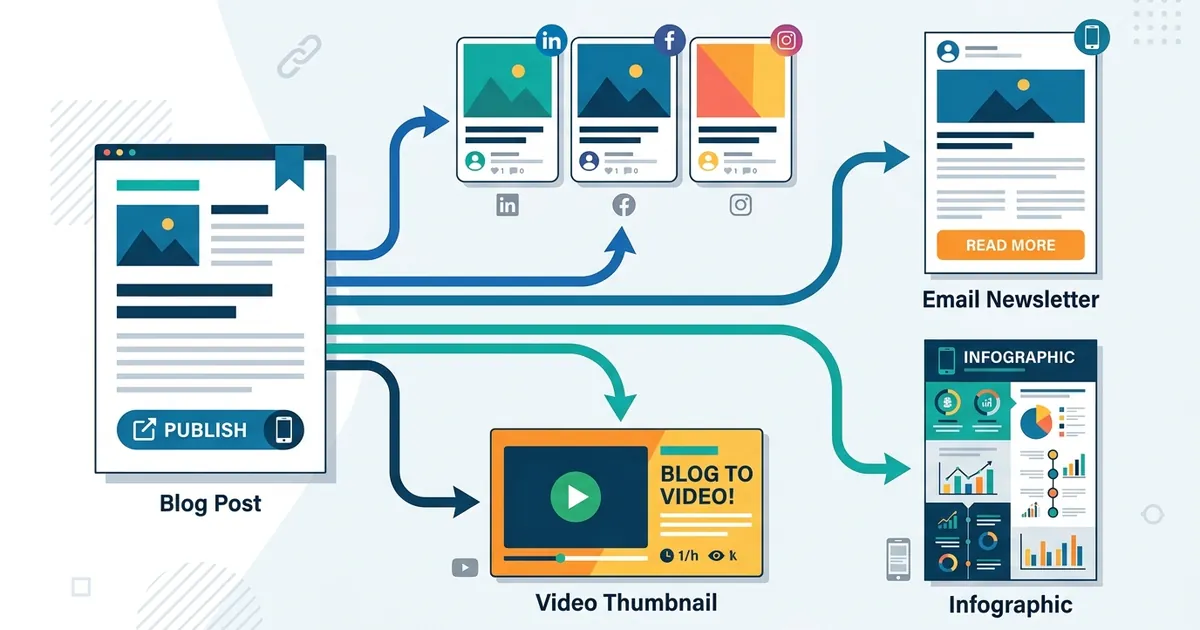
Content repurposing and distribution means taking a single high-performing article and breaking it into smaller pieces tailored to different platforms: social posts, email campaigns, videos, infographics, and more. Rather than treating each platform as a separate creation project, you extract atoms from existing content and reshape them for where your audience actually spends time. This approach works because 94% of marketers already repurpose their content, and 46% find it more effective than creating new material from scratch. For lean teams, it’s the difference between sustainable publishing and burnout.

Start with high-performing content
Not every blog post deserves repurposing effort. Pull your analytics and identify which posts have delivered the most traffic, engagement, and conversions. These are your core content assets—the pieces that already resonate with your audience. Focus your repurposing investment on winners, not on underperformers hoping they’ll gain traction in a second format.
Review the past six to twelve months of data. Look for patterns: Which topics generated the most shares? Which drove the deepest engagement? Which pieces brought qualified traffic that converted to leads or customers? These articles are your foundation. You’re not forcing content into new shapes; you’re amplifying what already works.
Small business owners who repurposed content reported 11–25% increases in engagement rates and 11–25% increases in conversion rates. That ROI comes from focusing on proven winners. Skip the middling posts and double down on what your audience wants.
Apply the 5-to-1 rule for social media
Extract at least five distinct social media posts from every long-form article. This isn’t a repost of the same message five times—each post stands alone and targets a different angle or audience segment.
Start by highlighting the atomic pieces: key statistics, surprising insights, actionable steps, quotes, and questions. A 2,000-word guide on content strategy might yield a post about the one counterintuitive tactic, another on the three metrics that matter most, a third asking readers which mistake they make most often, and two more offering quick tips. Each post should work without requiring readers to visit the original article.
Schedule these posts across 2–4 weeks to extend your reach to different audience segments and capture repeat traffic. The average blog post enjoys a 700-day lifespan with roughly 50% of its traffic arriving in the first week. Spreading repurposed content over weeks lets you tap into the remaining 50% that arrives later, and it ensures you’re not overwhelming followers with identical messaging on the same day.
Use platform-native formats for algorithmic advantage
A LinkedIn carousel performs differently from a Twitter thread, which performs differently from an Instagram Reel. Platform-native formats outperform simple cross-posts by 35–60%, so tailor your repurposed content to fit each platform’s feed algorithm and user behavior.
LinkedIn carousels reward multi-slide storytelling with professional visual hierarchy. Twitter threads work best for step-by-step processes or numbered insights. YouTube Shorts and TikTok favor quick hooks, upbeat pacing, and vertical video. The same insight formatted for each platform—rather than posted identically across all three—earns more algorithmic reach and engagement.
Short-form video (15–60 seconds) consistently ranks as the highest ROI format, requiring less production time and lower costs than longer pieces. Infographics work best when your goal is communication rather than deep analysis—they capture attention, make data memorable, and ensure your message resonates quickly. A 2,000-word guide can become three Instagram Stories showing one tip each, a 60-second TikTok demo of the most controversial tactic, and a LinkedIn carousel highlighting the top three insights.
Convert blog posts into email campaigns
Your email list is owned media. You control it entirely, and email consistently ranks among the highest-ROI distribution channels, with 30% of marketers citing it as their top performer and 43% rating it as medium ROI. Use blog posts to fuel multiple email campaigns.
Three methods work well: send the full post to engaged subscribers who prefer long-form content; use an excerpt with a link for larger lists where click-through rates tend to be higher; or create a roundup email grouping three to five related articles by topic with a brief connecting introduction. The roundup approach is especially practical for lean teams—you’re not creating new content, just organizing what exists and writing a short frame. One newsletter edition can generate three to five distinct email campaigns, each with a different angle or audience segment, building anticipation and social discovery around your blog.
Choose your method based on subscriber behavior and list engagement patterns. Highly engaged lists tolerate long-form emails; larger, newer lists respond better to excerpts and click-through paths.
Build a repurposing workflow for lean teams
The 80/20 principle applies directly to content: spend 20% of effort creating core content, allocate 80% to repurposing and distribution. This flips the script for small teams. Instead of publishing three new articles per week, publish one anchor piece—a blog post, video, or ebook—then systematically break it into smaller atoms across multiple platforms and formats.
Create one high-quality piece per week. Before publishing it, map out where each element will live: Which statistics go to email? Which tips become Instagram Stories? Which quotes become LinkedIn posts? Systematize the extraction phase using templates and AI summarization tools to speed up the initial work. An automated approach, such as Makasete’s weekly SEO article service for WordPress sites (from $40/month), handles the core article creation, freeing your team to focus entirely on repurposing and distribution without worrying about the underlying publishing infrastructure.
Schedule repurposed content 2–4 weeks after original publication to maintain ongoing presence and extend lifespan while preventing audience overwhelm. Solo founders and two-person teams can justify weekly publishing through systematic repurposing—you’re not working harder; you’re working smarter.
Atomization framework: breaking content into its smallest units
Atomization extracts individual claims, statistics, quotes, and processes from a single article. Each atom becomes a distinct social post, email snippet, or video clip that needs no context to stand alone.
A 10-step guide yields 10 Instagram Stories, each showing one step with a visual. A Q&A article becomes 5–7 standalone posts, each answering one question. Read the source, highlight key sentences, sort by platform type (email, LinkedIn, Twitter, Instagram), and assign each atom to its best-fit channel. This ensures nothing goes unused and reduces waste.
Prioritize owned and earned distribution channels
Don’t chase every platform. Choose two to four channels where your audience density is highest and invest deeply.
Owned channels (email, blog, your newsletter) deliver the highest ROI and build audience loyalty. Earned channels (LinkedIn, Reddit, Twitter, organic social) are where your audience already gathers and where algorithmic reach is free. Paid amplification works best only after a piece proves itself in organic channels—test selectively on winners only.
Brands running three to five distribution channels achieve 2.4 times higher content ROI than single-channel operators. The biggest gains come from pairing owned channels with at least one earned channel. Small businesses should avoid spreading thin. Focus on where your audience is densest, and measure channel performance monthly to reallocate effort toward traffic and conversion generators.
Measure repurposing ROI and iterate
Track impressions, clicks, conversions, and attribution back to the original article for each repurposed asset. Identify which formats and platforms deliver the highest engagement relative to effort spent. Short-form video and images consistently show the lowest production cost and highest ROI.
Use Google Analytics to measure traffic from social and email back to your blog posts. After 30–60 days of data, adjust your strategy based on what actually performed, not on gut feeling. Document repeatable winners so future content follows the same pattern. This iterative approach to measure the ROI of your content efforts means your team gets faster at repurposing over time.
Content repurposing is not a one-time tactic—it’s a repeatable system. When you streamline your content production workflow and apply systematic distribution, one article becomes five or more pieces of content, each reaching different segments of your audience across different platforms. The result is consistent visibility, lower per-piece production cost, and audience growth without requiring your team to work harder each week. Start by identifying your highest-performing post from the past six months. Extract three social posts from it this week. Measure the results. Build from there.