Local SEO keyword strategy is how small businesses compete for visibility in their service areas without outspending national chains. The goal isn’t to rank everywhere—it’s to rank for the searches that matter in your neighborhood, your city, or your delivery zone.
Fifty-one percent of Google searches have local intent. That’s not a niche audience. Yet most local businesses optimize haphazardly: they stuff their Google Business Profile with keywords, create identical location pages for 20 zip codes, or chase vanity terms like “best” that don’t drive phone calls or walk-ins.
A local SEO keyword strategy differs fundamentally from national SEO because proximity, relevance, and intent all shift based on where the searcher is standing. Understanding this difference—and building a research workflow around it—is what separates businesses that attract consistent local traffic from those that waste effort on the wrong terms.

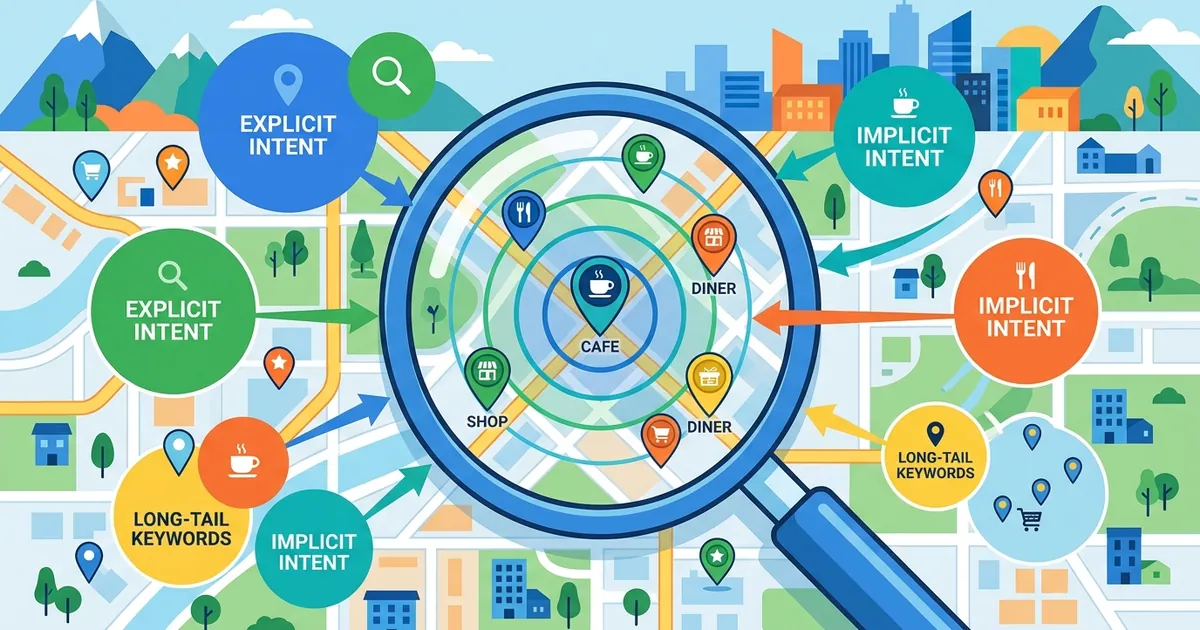
Explicit vs. implicit local intent: which keywords matter most
Explicit local keywords include a clear location modifier. “Plumber in Austin,” “dentist near me,” “emergency locksmith downtown Denver.” The searcher has stated both what they want and where they want it. These are conversion-ready. Google’s algorithm doesn’t have to guess intent because the person has already said it.
Implicit local keywords omit the location name but signal local intent through context. “Emergency plumber.” “Open now.” “Walk-in dentist.” Google’s algorithms detect these as local queries using IP address, past search history, and device signals. The algorithm decides how local the results should be at the time of the query, not based on the words alone.
The practical difference matters. Explicit keywords face moderate competition because not all businesses optimize for their location plus service together. They convert faster. Implicit keywords face less competition but require you to rank for proximity and relevance first.
The advantage: if you rank well for explicit long-tail keywords and maintain proper local SEO ranking factors, you’ll naturally rank for implicit variants too. You don’t need to optimize for both separately. Relevance overlap handles it.
Why explicit keywords dominate your local strategy
Searcher intent is unambiguous. They’ve narrowed the problem. Conversion likelihood is highest because the search has already qualified the location. This makes explicit keywords your primary targeting layer. Proper keyword research methodology starts here, not with generic head terms.
How to find explicit long-tail local keywords
Start with your core service and add location modifiers. “Web designer Brooklyn.” “Roof repair Denver.” “HVAC contractor Miami.” These are your seed keywords. Then expand.
Open Google’s search box and type your service, then your city. Capture every autocomplete suggestion. Mine the “People Also Ask” section by expanding each collapsed question—these reveal long-tail intent patterns competitors often miss. Check your Google Search Console for existing traffic; sort by query and filter for location terms you already rank for at positions 10–50. These convert despite low rank and often need only a small content push.
Review competitor Google Business Profiles and their review snippets. How do actual customers describe the problem they solved? “Burst pipe at 2 a.m.” beats “pipe remediation services” because it’s how real people talk. Listen to sales calls, scroll Reddit threads in your niche, check Facebook groups. The language people use conversationally differs sharply from keyword tool suggestions.
Long-tail keywords convert 2.5 times better than short-tail keywords. They typically attract 50 or fewer searches per month, yet even 50–100 monthly searches can be worthwhile in a local niche. The trade-off: lower volume, higher intent. An HVAC contractor targeting “emergency furnace repair in northwest Chicago” at 80 monthly searches will see more qualified calls than someone chasing “HVAC Chicago” at 2,000 searches.
Proximity ranking and why it constrains your keyword strategy
Distance accounts for roughly 55% of ranking power overall. In highly competitive fields like law, proximity reaches 67–69% influence. This is brutal and unavoidable. A competitor two miles away often outranks you for “service near me” despite weaker on-page SEO if they’re closer.
This reality forces a strategy shift: in dense urban areas, hyperlocal keyword targeting becomes essential. Don’t just target the city. Target neighborhoods, postcodes, subdivision names, local landmarks. “Dentist in Williamsburg Brooklyn” beats “dentist Brooklyn” because proximity matters less when relevance is extremely specific.
Multi-location businesses often stumble here by creating a global template, swapping city names, and calling it done. Each location needs genuinely unique content—different landmarks, different neighborhood demographics, different service area maps, different case studies. Forty to sixty percent of each location page should be original to avoid Google’s doorway page penalties and to actually signal relevance to the algorithm.
Optimizing your Google Business Profile without keyword stuffing
Your Google Business Profile description gets 750 characters. Use them naturally. Front-load your primary keyword—”Emergency plumber serving West Lake Hills, Austin”—but don’t repeat it four times. Embed two or three long-tail keywords if the sentence reads like English, not spam.
Verify your service categories accurately. Respond to reviews mentioning service-specific language to teach Google’s algorithm what you’re known for without stuffing.
Use Google Business Profile posts quarterly to test keyword variations and monitor engagement. This keeps the profile fresh and signals your business is active.
Customers in reviews use high-intent language: “fixed the leak same day,” “honest pricing,” “after-hours availability.” Mine these phrases and incorporate them into GBP descriptions, website FAQs, and landing pages. Google weights review language as a relevance signal.
Location pages: differentiation without duplication
Create location pages only for genuinely distinct geographic areas. Each must be at least 40–60% original, location-specific content to avoid Google’s doorway page penalties.
Include local landmarks, neighborhood demographics, case studies specific to each area. Link contextually to signal a genuine multi-location network.
Local SERP analysis and keyword feature mapping
Search your target keywords and note what features appear: map pack, organic results, People Also Ask, local ads. These reveal what Google rewards for that query and affect your content strategy.
Analyze the top three organic pages for keyword density, word count, and heading structure to understand what depth Google rewards for that search.
Building a local keyword strategy workflow
Week 1: Seed keywords. List five to ten core services and brainstorm location modifiers, neighborhood names, postcode terms tied to each.
Week 2: Expand. Run Google Autocomplete, People Also Ask, and free tools (Google Trends, Google Search Console, Ubersuggest free tier) to capture variants and emerging searches.
Week 3: Prioritize. Score each keyword by monthly search volume (target 100–1,000 for local), competition level, and conversion likelihood based on intent. Eliminate vanity keywords.
Week 4: Map to pages. Assign keywords to your Google Business Profile, homepage, location pages, and blog content. Avoid keyword cannibalization—each page should own a distinct keyword set.
Quarterly, review rank movement, traffic by keyword, and metrics like calls and direction requests to avoid optimizing for vanity metrics instead of conversions.
This workflow focuses effort on searches that convert. Automating research and content updates—quarterly keyword refreshes, monthly blog posts tied to emerging searches—enables consistent growth. Building topical authority with strategic content clustering reinforces local relevance signals.
Small teams often lack capacity for manual quarterly reviews. An automated weekly SEO article service for WordPress sites (from $40/month) can handle this cadence, executing keyword research and publishing aligned content without adding headcount. The mechanics matter less than the consistency. Rank movement in local SEO takes three to six months to show; the teams that maintain momentum are the ones that publish, refresh, and monitor—every single week.
The fundamentals remain: explicit keywords convert faster, proximity constrains your reach, and relevance signals compound over time. A deliberate strategy built on these three principles, executed consistently, delivers traffic that actually walks in the door or picks up the phone.