Topical authority building: how to strategically cluster content to build domain expertise signals is no longer optional for sites competing in organic search. Search engines—and the AI systems they power—now reward sites that cover topics thoroughly and credibly rather than those chasing isolated keywords across disconnected pages. A recent analysis from December 2025 confirmed that topical authority was the single strongest predictor of algorithm update performance. This shift means newer sites with tightly focused, well-connected content sometimes outrank older, more established domains that built their authority on legacy pages. Content clusters drive approximately 30% more organic traffic and hold rankings 2.5 times longer than standalone pieces, according to HireGrowth’s 2025 data.

What topical authority actually is
Topical authority represents comprehensive knowledge on a subject—the kind that signals to search engines you provide reliable, thorough information rather than surface-level keyword optimization. It improves user experience through intuitive navigation paths and reduces bounce rates because visitors find related content easily. The signal is clearest when your site demonstrates expertise across multiple angles of a single topic, not when it dabbles in a hundred subjects at once.
Google’s June 2025 core update reinforced this principle. Sites covering subjects thoroughly and credibly now outrank those relying solely on historical domain authority. This is a meaningful inversion: a domain with zero backlinks can build topical authority in six months through structured content clusters, while a high-authority site covering 100 topics superficially can lack credibility in every niche.
The pillar-and-cluster architecture explained
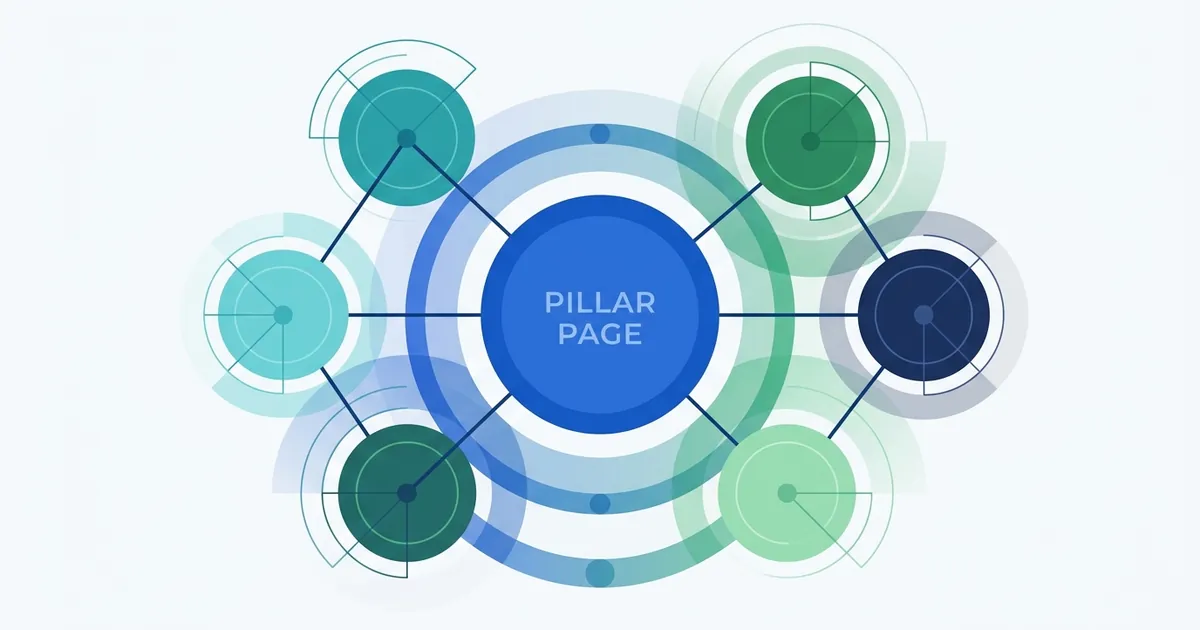
The pillar-and-cluster model is a straightforward content architecture that demonstrates topical depth to search engines. At its core: a central pillar page provides comprehensive coverage of a broad topic (typically 3,000–5,000 words), while multiple cluster pages dive deep into specific subtopics or angles (700–1,800 words each). The pillar and cluster pages link to each other bidirectionally, creating what’s sometimes called a hub-and-spoke content model—a web of interrelated content that tells search engines and AI systems you understand a subject thoroughly.
The distinction matters. A pillar page isn’t just a longer version of a cluster article; it’s an end-to-end overview that addresses the topic comprehensively while pointing readers to deeper explorations. A cluster page zooms into one angle and links back to the broader pillar, plus to sibling cluster pages covering adjacent subtopics.
Concrete example: a pillar on “WordPress SEO” might have cluster pages on “Technical SEO Fundamentals,” “Core Web Vitals for WordPress,” “On-Page Optimization Best Practices,” and “Internal Linking Strategy.” Each cluster targets a specific query intent and covers its subtopic with depth; the pillar stitches them together into a coherent knowledge system.
Building your internal linking strategy
Bidirectional linking is the glue that makes this architecture work. The pillar links to each cluster page with descriptive anchor text—not generic “read more” or “click here,” but phrases like “learn how to audit your technical SEO” or “implement an internal linking strategy.” Cluster pages link back to the pillar and to sibling clusters where relevant, reinforcing topical relevance and distributing PageRank authority throughout the cluster.
Anchor text itself is part of the authority signal. When you link from one cluster page to another using contextual phrases, you’re telling search engines what the destination page is about. This matters because AI systems (LLMs, Google’s AI Overviews) follow internal link patterns to understand site structure and how your content pieces relate to each other.
Introduce cluster pages gradually. Start with four to six strong foundational articles, then expand based on audience demand and search data. Avoid the temptation to over-link or manufacture anchor text patterns that feel unnatural; search engines notice when internal links exist solely to game rankings rather than serve the reader.
How content clustering strengthens E-E-A-T signals
Google’s E-E-A-T framework (Experience, Expertise, Authoritativeness, Trustworthiness) is critical for ranking, and content clusters demonstrate all four dimensions simultaneously. Here’s how:
Experience surfaces when your cluster articles discuss real-world scenarios, edge cases, and nuance that only someone who’s done the work would understand. Expertise comes through deep, in-depth coverage of a topic from multiple angles—the opposite of surface-level keyword optimization. Authoritativeness builds when cluster pages cite and link to original research, case studies, and authoritative sources within your own content network. Trustworthiness emerges because comprehensive coverage reassures both readers and search engines that you’re not hiding relevant information or pushing a narrow agenda.
A cluster on “AI Content Tools” with articles benchmarking tools against each other, analyzing cost-benefit tradeoffs, and reviewing fact-checking approaches signals more genuine expertise than a single comparison post. The breadth itself is evidence of knowledge.
Semantic SEO and preparing for AI search
Semantic SEO optimizes for meaning, intent, and entity relationships rather than isolated keywords. Topic clusters make your content easier for AI systems to cite because you’re covering topics comprehensively from every angle. Well-structured clusters receive 3.2 times more citations in AI Overviews—the AI-generated answer boxes now appearing on roughly 50% of searches.
When an AI system encounters a user query, it breaks it into multiple sub-queries and stitches information from many passages into a single coherent answer. A tightly organized cluster provides exactly what these systems need: multiple passages covering the same topic from different perspectives, with clear internal relationships that signal relevance.
Schema markup and structured data help too. By positioning your site as a knowledge system rather than just a collection of blog posts, you make it easier for AI to understand not just what you say, but how your content pieces fit together. This is distinct from the old keyword-density playbook; it’s about demonstrating that you model expertise the way humans do—through breadth, depth, and connection.
Building your cluster strategy: a practical workflow
Start with a pillar topic where your business has genuine expertise and clear market demand—a high-intent keyword you actually own knowledge in. Then identify four to six initial subtopic clusters through keyword research methodology that underpins topical clustering, competitor analysis, and direct customer questions. Audit existing content to see what already maps to the cluster (repurposing always beats starting from scratch), and identify the gaps.
Write the pillar page first. It’s your foundation. Then fill in cluster articles sequentially, aiming for 700–1,800 words each and targeting one specific subtopic per article. Implement bidirectional internal links as you go, using the anchor text patterns mentioned earlier.
A solid pillar plus four to six clusters typically takes two to three months to launch. Success usually compounds from there: sites publishing 25 or more articles in a single cluster see 40–70% keyword ranking increases within three to six months. Automated content platforms can accelerate this timeline significantly. For example, Makasete’s automated weekly SEO article service for WordPress sites (from $40/month) handles the keyword research, outline design, writing, fact-checking, and publishing steps, freeing lean teams to focus on strategy, gap analysis, and performance measurement without the overhead of a traditional agency.
Measuring topical authority over time
Track organic traffic growth across the pillar and cluster pages. Early-stage clusters show ranking movement within weeks, but the compounding effect emerges over six to twelve months as authority signals accumulate. Expect 30–40% traffic increases as clusters mature; some documented cases show 100x multiplier effects when implementation is rigorous.
Monitor keyword breadth. How many keywords do your cluster pages rank for? Well-structured clusters expand your keyword footprint significantly because you’re covering topics from every angle. Measure AI citation visibility by tracking how often your content appears in AI Overviews and which specific passages get cited.
Analyze user behavior: time on site, pages per session, and bounce rates should all improve as cluster navigation becomes intuitive. Use Google Search Console to identify content gaps and ranked keywords with low click-through rates—these are your expansion opportunities. Build additional cluster pages for high-intent keywords with low competition, unanswered customer questions, and emerging topics within your domain.
When you’re ready to scale beyond your first cluster, apply the same playbook to adjacent topics. A cluster on WordPress SEO (using the broader WordPress SEO strategy framework) could expand into content marketing, then into AI automation. Each new cluster adds topical authority to overlapping domains, multiplying your reach.
The compound effect is real. Teams that treat content clustering as a system rather than a one-off project see organic traffic double and triple. The difference is consistency and strategic patience—building depth in one area before sprawling into ten. Automating the streamlined content production workflow removes the friction that stops most teams from maintaining this discipline.